Scaling Gas Town: From Frontier to Production
Gas Town is one of the first real examples of multi-agent orchestration at scale: parallel workers, durable workflows, merge arbitration. It demonstrates the Time-to-Value Loop (Vibe → Forge → Mature) on the frontier. Production Town is what it takes to bring that power into organizations.

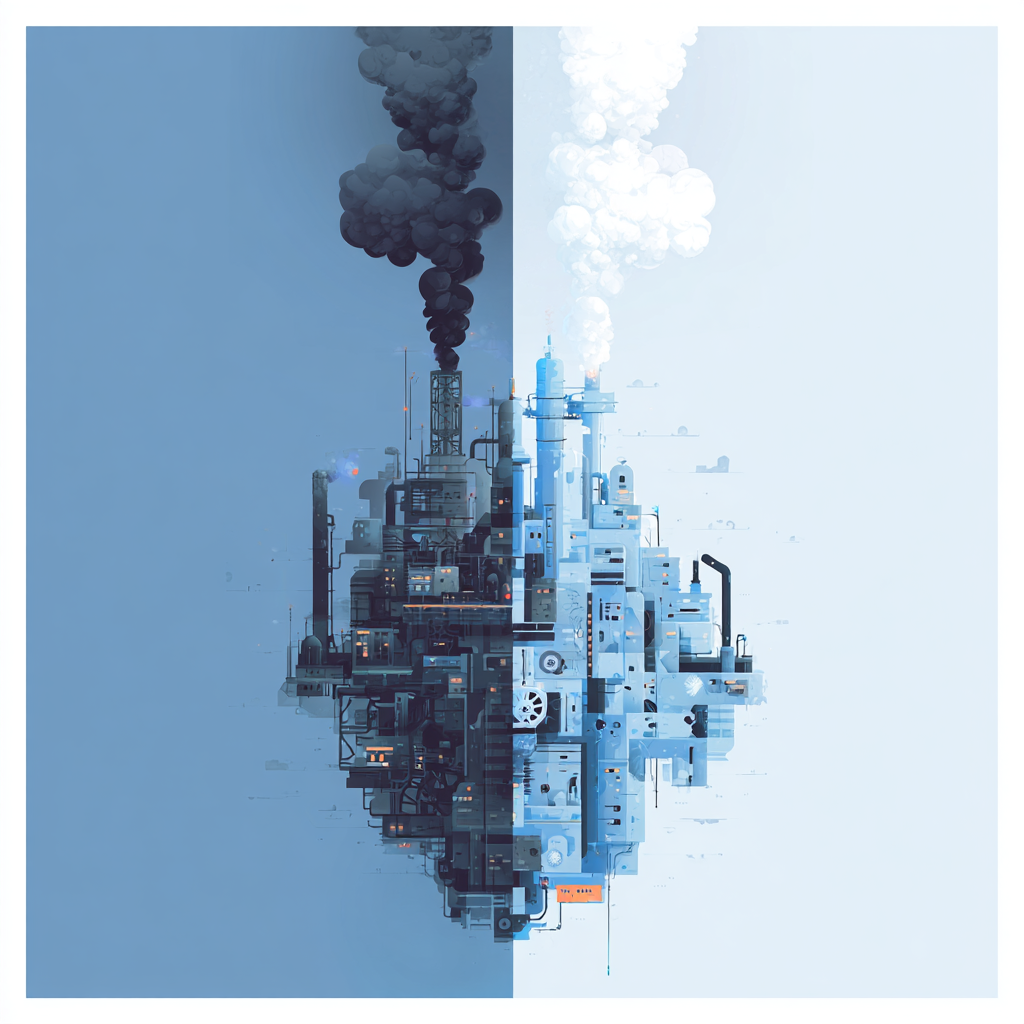
Steve Yegge’s Gas Town is one of the clearest signals yet that AI-assisted software development is entering a new phase.
Not “AI helps me write code faster.”
Not “I can generate a component in 30 seconds.”
Something bigger.
Gas Town is what happens when you stop treating AI like a copilot and start treating it like a workforce.
It’s chaotic. It’s theatrical. It’s provocative.
And underneath the theatrics is a very real truth: AI coding is becoming a distributed systems problem.
The question is not whether we can produce more code. We can.
The question is whether we can turn that throughput into real outcomes inside real delivery systems.
Because the bottleneck is no longer “writing code.”
It’s turning code into value.
That’s the loop I’ve been using to make sense of what’s happening in real teams right now:
Vibe → Forge → Mature
I call it the Time-to-Value Loop.
And what’s fascinating about Gas Town is this:
It’s one of the first public systems I’ve seen that makes the Time-to-Value Loop feel concrete.
Gas Town isn’t just “vibe coding chaos.” It’s an orchestration system that already contains the beginnings of all three phases.
The real question is what it takes to carry those ideas from Gas Town into Production Town, where teams, constraints, governance, and repeatability become the point.
What Gas Town Gets Right
Let’s start with the obvious: Gas Town is not a toy idea.
It’s a big bet on the thing most AI tooling still ignores.
1) Parallelism is the next frontier
Most teams are still stuck in “one developer, one agent, one chat.”
Gas Town says: why are we doing that?
If AI agents can work concurrently, then the whole workflow changes:
- multiple workstreams at once
- multiple approaches in parallel
- multiple experiments running continuously
- a real “factory line” of change
That’s not just productivity.
That’s a new operating model.
2) Merge queues become the battlefield
Once you have multiple agents producing output simultaneously, you immediately collide with reality: integration is hard.
You don’t just need generation. You need:
- coordination
- sequencing
- arbitration
- conflict resolution
- rollback paths
- trust gates
Gas Town is effectively yelling:
“Welcome to the merge queue industrial revolution.”
He’s right.
3) Orchestration is the product
This is the biggest signal in the whole thing:
The future is not a smarter autocomplete.
The future is orchestration primitives:
- persistent work units
- roles and specialization
- state management
- structured workflows
- tool execution as a first-class capability
Gas Town is not just a workflow tweak.
It’s a glimpse of the substrate that’s coming next.
The Real Problem: Throughput Scales Faster Than Organizations
Here’s the uncomfortable truth:
Even when you build orchestration, throughput introduces a new class of failure modes.
Not because the system is “undisciplined.”
But because throughput creates pressure.
Pressure on:
- review capacity
- test quality
- integration stability
- decision-making speed
- operational safety
- cost control
This is the pattern I’ve seen repeatedly over the last year: AI makes implementation faster, but delivery doesn’t automatically get faster.
Sometimes delivery gets slower, because the downstream system can’t keep up:
- QA becomes the bottleneck
- PR review becomes the bottleneck
- integration becomes the bottleneck
- decision-making becomes the bottleneck
And when those bottlenecks hit, teams do what teams always do:
They ship chaos.
Or they freeze.
Either way, the promise collapses.
That’s not a tooling problem.
It’s an operating model problem.
The Time-to-Value Loop: Vibe → Forge → Mature
Here’s the model I’ve been using to make sense of AI-native delivery.
Phase 1: Vibe
Goal: Generate options fast and find the shape of the solution.
Vibe is:
- fast exploration
- rapid iteration
- “try three approaches”
- prototype workflows
- cheap discovery
- momentum
Gas Town clearly amplifies this, especially through swarms and parallelism.
But Vibe has a failure mode: Vibe produces plausible output, not dependable systems.
So Vibe is not the destination.
It’s the front door.
Phase 2: Forge
Goal: Turn promising output into a coherent, constrained system.
Forge is where you:
- lock down interfaces
- define invariants
- add tests that matter
- align on architecture
- simplify complexity
- choose the “one path” forward
- reduce degrees of freedom
This is the phase where “we generated a lot” becomes “we built something coherent.”
In Gas Town terms, this shows up in places like:
- Molecules and acceptance criteria
- structured workflows that survive restarts
- the Refinery’s role in integrating change safely
Phase 3: Mature
Goal: Make it safe, observable, and shippable.
Mature is where you:
- add eval gates
- add observability (traces, metrics, failure analysis)
- harden security boundaries
- validate behavior continuously
- build rollback and recovery paths
- operationalize the system
This is what turns “cool demo” into “real capability.”
And while Gas Town already has real durability and operational primitives (Git-backed state, patrol loops, persistent identities), this is the phase that becomes non-negotiable the moment you bring the system into an organization.
Gas Town Through the Time-to-Value Lens
Here’s the mapping that makes Gas Town click for me:
| Gas Town Concept | What It Represents | Time-to-Value Translation |
|---|---|---|
| Many agents running at once | Parallelized delivery | Vibe at scale |
| Polecats / swarms | High-throughput execution | Vibe |
| Molecules / formulas | Structured workflows | Forge |
| Refinery / Merge Queue | Integration arbitration | Forge + Mature |
| Patrols / Witness / Deacon | Reliability and continuity | Mature |
| Git-backed Beads + durability | Recoverability + traceability | Mature |
Gas Town is basically a megaphone for this truth:
The future is multi-agent, not single-agent.
But the part that decides winners and losers is what happens after the swarm produces output.
Why Most Teams Will Struggle Copying Gas Town
Here’s the part I’ll say plainly:
Most teams are going to look at Gas Town and copy the aesthetic, not the operating model.
They’ll try to scale agent throughput without understanding what makes it work:
- durable work units
- workflow structure
- merge arbitration
- supervision roles
- restart and recovery mechanics
That’s how you get:
- more PRs than reviewers
- more changes than tests
- more output than understanding
- more speed than confidence
And then leadership will ask the question that always shows up:
“Why are we moving faster but delivering less?”
That’s the AI delivery trap.
It’s not a tooling problem.
It’s a system problem.
What “Production Town” Requires (Beyond the Frontier)
Gas Town is a frontier system built for a frontier operator.
Production Town is what happens when you need the same power, but inside a real org.
That means adding constraints like:
Forge (org-scale conversion)
- architecture decision records for major changes
- “one spec to rule them all” per work unit
- test-first or test-with development as a default
- enforced boundaries (modules, services, contracts)
- design constraints agents must follow
The goal is simple: reduce degrees of freedom so output becomes predictable.
Mature (org-scale safety)
- eval harnesses tied to business risk
- traceability from intent → changes → outcome
- runtime observability for agent workflows
- security policies around tool access
- staged rollout patterns (feature flags, canaries)
- rollback paths that actually work
This is the difference between:
“we generated code”
and
“we built a system we can trust.”
The Real Takeaway
Gas Town is not “the future of software development.”
Gas Town is a flare shot into the sky that says:
The next era is orchestration.
It’s a glimpse of what happens when AI output becomes industrialized.
And it makes one thing painfully clear:
The bottleneck has moved.
Not to coding.
To:
- integration
- quality
- trust
- operational safety
- decision-making
That’s why the Time-to-Value Loop matters.
Vibe gets you motion.
Forge gets you coherence.
Mature gets you value.
If You’re Building This Right Now
Here’s the practical playbook I’d recommend:
- Use Vibe aggressively
Explore fast. Prototype quickly. Generate options. Run parallel experiments. - Forge deliberately
The moment you see a promising path, constrain it:
- lock interfaces
- write tests
- reduce complexity
- align on “the one thing”
- Mature continuously
Don’t wait until the end to add safety.
Add evals, observability, and operational controls as you go.
Because the teams that win won’t be the ones who generate the most code.
They’ll be the ones who can ship reliable capability repeatedly.
Closing
Gas Town is loud, weird, and deeply inspiring.
But the deeper truth underneath it is dead serious:
AI development is becoming a system.
And systems need loops.
If you want to turn agentic throughput into real delivery outcomes, you need a loop that converts motion into value:
Vibe → Forge → Mature
That’s the Time-to-Value Loop.
And “Production Town” is what happens when you operationalize that loop for teams, not just for the frontier.