Harness Observability: The Next Loop in AI Engineering
Skills package capability. Harnesses determine how that capability performs in production. This article explores three nested control loops and shows how observability becomes governed adaptation, with evidence passing through evaluation and policy before it can safely steer execution.


Over the past year, the AI community has become very good at packaging expertise. Prompt libraries became skills, skills became reusable components, and public registries are beginning to make thousands of capabilities available across Claude, Cursor, Gemini, Copilot, and other AI platforms.
This is an important step forward, but skill registries are not the destination. They are the beginning of a much larger capability ecosystem.
The next generation of AI engineering will not be defined by better prompts or larger skill libraries. It will be defined by harnesses that observe how capabilities perform in production, accumulate evidence across executions, and steer future work through governed control loops.
The skill stays the same. The harness gets smarter.
We Have Seen This Evolution Before
Software engineering has followed this pattern repeatedly. We started by copying code between projects, then created libraries, and eventually built package managers.
npm, NuGet, Maven, Cargo, and PyPI did not transform software merely because they stored code. They standardized discovery, versioning, dependencies, compatibility, distribution, ownership, and trust.
AI skills are beginning the same journey. Today’s skill registry is tomorrow’s capability ecosystem.
Packaging Is Only the First Step
A typical AI skill today might look something like this:
Review Pull Request

Description
Instructions
Examples
That makes knowledge reusable, expertise portable, and capabilities shareable. But it does not make them operational.
A production-ready capability needs more:
Review Pull Request

Version: 2.4.1
Dependencies
Permissions
Compatibility
Security Signature
License
Owner
Evaluation Profile
Operational Limits
At that point, the prompt becomes only one part of the package. The package becomes the product.
But packaging, versioning, and distribution are still only the foundation. The larger opportunity begins when those capabilities are repeatedly executed inside production systems and each execution leaves behind evidence about how the capability actually behaved.
Every Skill Execution Produces Evidence
Every time a skill executes, the harness receives evidence about the execution conditions and resulting outcome. It can capture token consumption, execution time, cost, model selection, tool calls, retrieved context, files accessed, evaluation results, retries, failure reasons, and the edits people make after the output is produced.
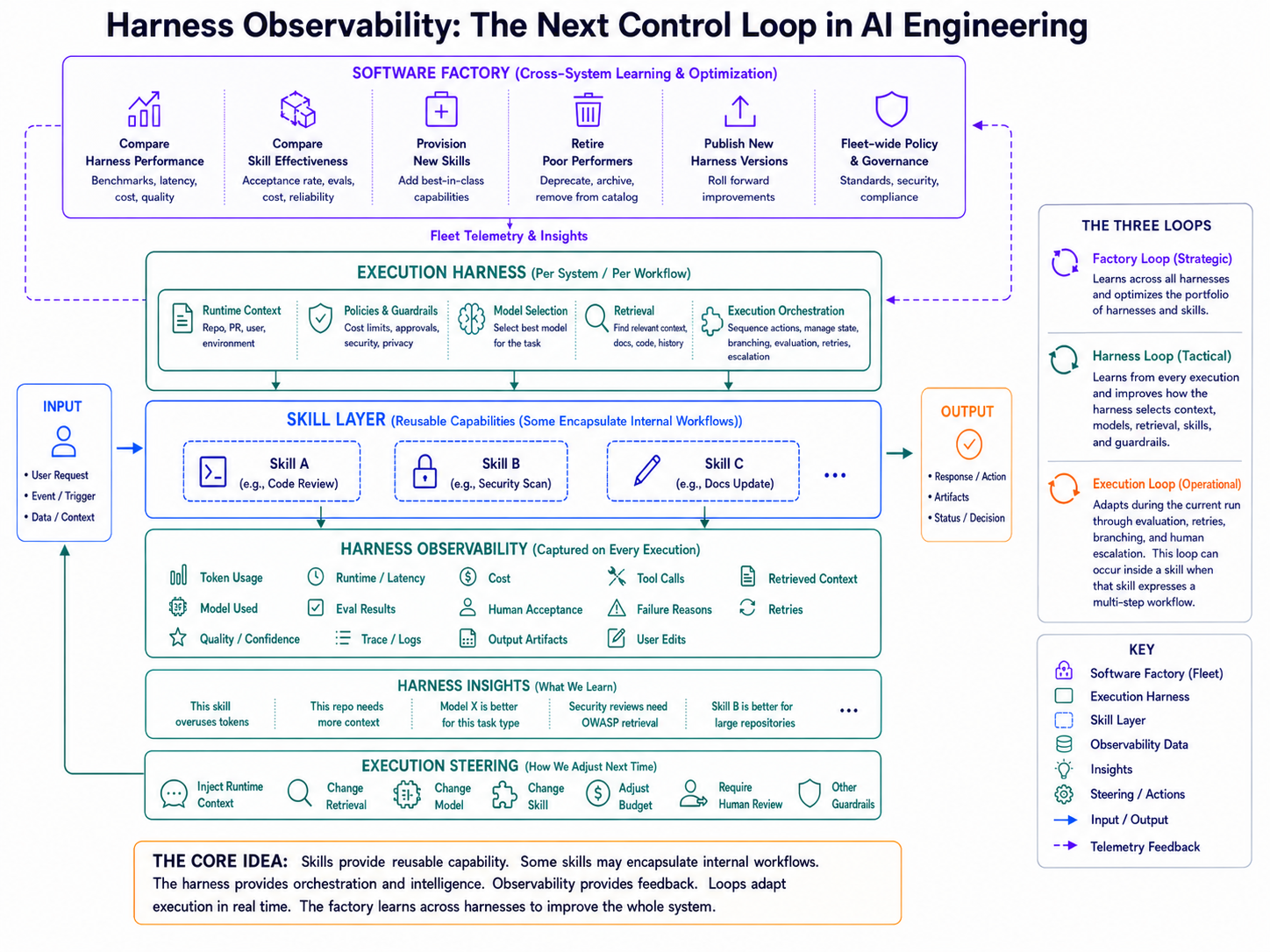
None of those signals belongs inside the skill itself. The skill defines reusable capability, while the harness controls the execution environment and records what happened within it.
Across hundreds or thousands of runs, these observations begin to reveal how a capability behaves across repositories, domains, models, contexts, and task types.
Every execution gives the harness evidence. Learning emerges from the accumulated pattern.
Observability Creates Harness Insights
Imagine a code-review capability that has executed several thousand times. The evidence shows that it performs exceptionally well on small pull requests, but its accuracy declines on changes larger than 500 lines.
Human reviewers frequently rewrite its security recommendations. Average token consumption doubles when more than 50 files are retrieved, and latency increases sharply when full repository history is included. Results improve when approved OWASP guidance is retrieved for authentication-related changes.
These are not necessarily failures. They are conditional performance patterns.
The harness is developing an evidence-based understanding of where the capability performs well, where it struggles, and under which conditions it creates the most value.
This is observability applied to AI execution. It is more than logs and dashboards. It is behavioral evidence about the relationship between execution conditions and outcomes.
Harness Insights Become Runtime Steering
Traditional systems already use telemetry to adjust routing, scaling, congestion control, and other operational parameters. AI harnesses extend that idea into the semantic execution environment itself: the instructions, context, tools, models, constraints, and evaluation criteria presented to a capability.
The harness does not necessarily need to rewrite the skill. It can improve the environment in which the skill executes.
Before invoking a code-review capability, the harness might inject guidance such as:
Pull request contains more than 500 changed lines. Prior executions show reduced accuracy at this size. Review modified modules independently, then perform a separate cross-module dependency check.
For an authentication-related change, it might retrieve an approved security standard before analysis begins:
Previous reviews of authentication changes in this repository required additional security analysis. Retrieve the approved OWASP guidance before generating recommendations.
When recent executions have exceeded their approved budget, it might narrow the task:
Token usage exceeded the approved budget during recent executions. Avoid reviewing generated files and produce concise findings unless additional analysis is explicitly required.
The underlying capability remains reusable, but its execution becomes conditional.
Production evidence becomes execution guidance without forcing the skill itself to change.
Observation Is Not Authorization
This does not mean every observed correlation should immediately become runtime guidance. Production evidence can be noisy, misleading, incomplete, or actively manipulated.
A local improvement in cost may reduce quality elsewhere. Repeated human corrections may represent personal preference rather than an actual capability failure. Prompt injection, poisoned retrieval sources, or compromised tools may contaminate the evidence itself. A system optimized too aggressively for acceptance rate may quietly degrade security, originality, or long-term maintainability.
A production-grade harness therefore needs a boundary between observation, inference, and authorized adaptation.
Confidence thresholds determine whether a pattern is meaningful. Evaluations test proposed changes against known expectations. Policies constrain what the harness may alter. Versioning and rollback make adaptations reversible, while higher-risk changes may still require explicit human approval.
The control loop is not:
Observe a pattern, then change the prompt.
It is:
Observe evidence, infer a pattern, validate the intervention, authorize the change, and monitor the result.
Observability produces evidence. The control plane decides when that evidence is strong enough to change execution.
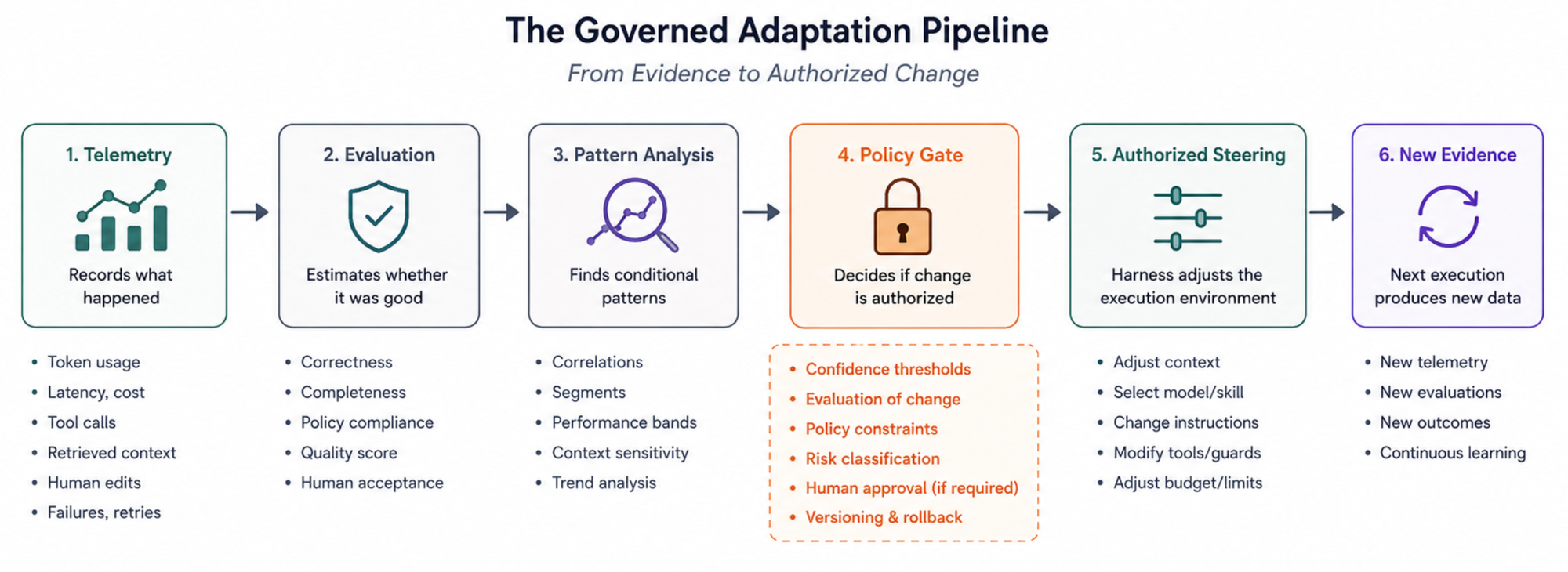
That boundary separates a governed adaptive system from an uncontrolled self-modifying prompt loop.
The Control Loop Has Four Distinct Stages
It is useful to separate the mechanism into four stages.
Telemetry records what happened. It captures the execution record, including inputs, context, model, skill, tool calls, latency, cost, retries, outputs, and human corrections.
Evaluation estimates whether the outcome was good. It measures correctness, completeness, policy compliance, cost efficiency, human acceptance, or other properties that matter for the task.
Analysis identifies conditional patterns. It looks across executions to understand where a capability performs well or poorly. The meaningful question is rarely whether a skill is globally good or bad. It is usually: Under which conditions does this capability perform well?
Policy determines whether execution changes. The control plane decides whether an inferred pattern is strong enough, safe enough, and sufficiently general to influence future runs.
Telemetry does not directly become guidance. It becomes evidence that may support an authorized intervention.
This Is Why Harnesses Matter
The feedback loop becomes part of the architecture:
Skill Executes
      ↓
Telemetry Records What Happened
      ↓
Evaluations Estimate Quality
      ↓
Analysis Identifies Conditional Patterns
      ↓
Policy Authorizes an Intervention
      ↓
The Harness Adjusts the Execution Environment
      ↓
The Next Execution Produces New Evidence
Every execution produces new evidence. Over time, validated evidence can influence retrieval, model selection, skill selection, execution budgets, domain context, evaluation criteria, or human-review requirements.
The harness continuously asks a practical question:
Given the evidence accumulated from production, how should the next execution be different?
This is more than prompt steering. It is execution steering.
Evals Become More Than a Score
Evaluations are often treated as pass-or-fail tests. They are useful and necessary, but incomplete.
Their real value emerges when evaluation results are combined with production telemetry, human behavior, and operational outcomes.
Imagine that evaluation scores and human acceptance remain high while token consumption doubles over the course of a month. The capability is still producing correct results, but it is becoming less efficient.
Now imagine that aggregate evaluation scores remain stable while human overrides steadily increase for financial documents. The overall score appears healthy, but the harness has uncovered a domain-specific weakness that the aggregate evaluation hides.
Neither insight is visible from an evaluation score alone.
Together, telemetry, evaluations, human corrections, and operational outcomes create the evidence required for controlled adaptation.
The Three Loops
The architecture becomes clearer when we distinguish three control loops.
The Execution Loop
The execution loop operates during the current run. A skill may express a multi-step internal workflow that retrieves context, invokes tools, evaluates intermediate results, retries when confidence is low, branches based on findings, or escalates to a human.
This loop adapts the current task.
The Harness Loop
The harness loop operates across repeated executions within a system or workflow. It accumulates evidence about which context, models, retrieval strategies, skills, budgets, and guardrails work best under particular conditions.
This loop changes how the next run is configured.
The Factory Loop
The factory loop operates across the fleet. It aggregates evidence across harnesses, repositories, teams, domains, models, and capability versions.
A factory can compare harness performance, evaluate skill versions, provision new capabilities, retire weak performers, publish updated harness configurations, and enforce shared governance.
The execution loop improves the current run. The harness loop improves the next run. The factory loop improves the ecosystem.
The Competitive Advantage Moves
Many organizations will assume that owning thousands of skills creates a durable competitive advantage. I do not think it will.
Public registries will continue to grow, and skills will become easier to package, distribute, and standardize, just as software packages did. The competitive advantage therefore moves upward into the systems that determine how capabilities are selected, configured, evaluated, and governed.
A single harness can learn how a capability behaves within one workflow. A factory can aggregate that evidence across harnesses, teams, repositories, domains, models, and capability versions. It can identify which combinations work best under which conditions, then govern what gets provisioned into each execution environment.
The important questions are no longer simply whether a skill exists. They are whether the system can observe capability performance, detect regressions, distinguish local patterns from general ones, optimize cost without degrading quality, govern which insights become policy, roll changes out gradually, reverse them safely, and prevent hostile inputs from poisoning the feedback loop.
Those are harness, control-plane, and factory problems.
The moat is not the trace. The moat is the system that reliably converts evidence into governed execution policy.
From Dashboards to Adaptive Systems
The largest mindset shift is how we think about observability.
Today, observability is often used to understand what happened. In adaptive AI systems, it can also help determine what should happen next.
Operational data becomes evidence. Evaluation results become conditional routing signals. Human corrections expose domain weaknesses, and production patterns inform execution policy.
But none of those signals should bypass governance.
The harness develops evidence about how to operate the system better. The control plane decides which adaptations are safe enough to apply. The factory determines which lessons should remain local and which should become improvements across the fleet.
Looking Ahead
Five years from now, I do not think we will spend much time discussing prompt engineering as a standalone discipline. We may not spend much time discussing skill engineering either.
We will be building adaptive capability platforms that package and version reusable capabilities, observe every execution, evaluate quality and operational outcomes, identify conditional performance patterns, validate insights before acting on them, authorize adaptations through policy, steer future execution, and learn across systems and teams.
The prompt becomes an implementation detail. The skill becomes a reusable capability package. The harness becomes the adaptive execution system.
The control plane becomes the authority boundary. The factory becomes the learning system across the fleet.
Observability becomes the evidence mechanism that allows the platform to improve without becoming uncontrolled.
The future of AI engineering is not just better skills. It is harnesses that know how to use those skills better, supported by control planes that know when the evidence is strong enough to permit change.